
Newark Uber Accident Lawyer
Trusted rideshare accident lawyers with over 30 years of experience.
If you have been injured in an Uber or Lyft accident in Newark, one of the first questions you will face is who is responsible and whose insurance should be covering your medical bills. Rideshare accidents involve layered insurance policies that shift depending on what the driver was doing at the moment of the crash, and determining which policy applies requires an understanding of how the rideshare companies structure their coverage.
The Law Offices of David A. DiBrigida have represented accident victims across New Jersey since 1992. Our Newark, NJ Uber accident lawyer understands the insurance framework behind Uber and Lyft claims and knows how to identify the right policy for your situation. We offer free consultations and collect no fee unless we recover money on your behalf.
Uber Accident Lawyer Newark, NJ
n a standard car accident, the at-fault driver’s personal auto policy covers the damages. In a rideshare accident, the coverage depends on the driver’s status at the time of the crash. New Jersey’s Transportation Network Company law (P.L. 2017, c.26) requires companies like Uber and Lyft to carry specific levels of insurance, but those levels change based on whether the driver was logged into the app, waiting for a ride request, or actively transporting a passenger.
An Uber accident attorney in Newark needs to determine which coverage phase applies, because it directly affects how much insurance is available to cover your injuries. Getting this wrong at the outset can mean filing against the wrong policy and delaying your recovery for months.
Types of Rideshare Accident Cases We Handle in Newark
Newark’s density, its busy intersections, and its proximity to Newark Liberty International Airport make it one of the most active rideshare markets in New Jersey. We handle rideshare injury claims across the full range of scenarios that arise in the city.
- Accidents caused by rideshare drivers. When an Uber or Lyft driver causes a collision through distracted driving, running a red light, or speeding, the rideshare company’s insurance policy may cover the injured parties. The amount of available coverage depends on the driver’s status in the app at the time of the crash.
- Accidents caused by other drivers. If another motorist hits a rideshare vehicle while you are a passenger, you may have claims against that driver’s insurance, the rideshare company’s uninsured or underinsured motorist coverage, or both. These cases often involve negotiating with multiple insurers at the same time.
- Passenger injuries in rideshare vehicles. Passengers injured during an Uber or Lyft ride are generally covered by the rideshare company’s $1.5 million liability policy, provided the driver was on an active trip. As a passenger, you are almost never at fault, which simplifies the liability question but does not simplify the claims process.
- Pedestrian and cyclist rideshare accidents. Rideshare drivers in Newark frequently stop or pull over in dangerous locations to pick up or drop off passengers. Pedestrians and cyclists struck by rideshare vehicles have the same right to pursue compensation as any other accident victim.
- Multi-vehicle rideshare collisions. A rideshare accident at a busy Newark intersection can involve three or more vehicles. These cases require sorting out fault among multiple drivers and identifying which insurance policies apply.
- Wrongful death rideshare claims. When a rideshare accident results in a fatality, the victim’s family may pursue a wrongful death claim against the at-fault driver, the rideshare company, or both.
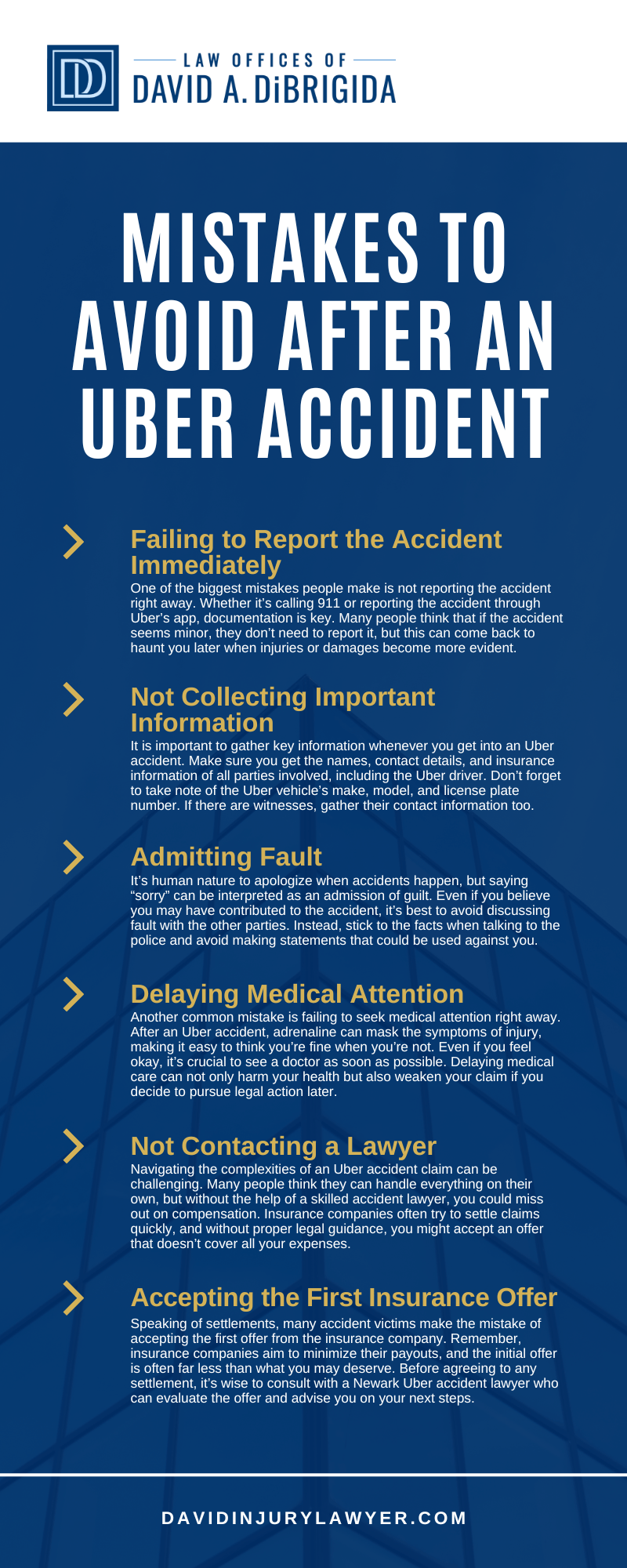
Newark Uber Accident Infographic
Why Choose the Law Offices of David A. DiBrigida for Uber Accident Cases in Newark, NJ?
Representing Accident Victims Since 1992
David A. DiBrigida has spent over 30 years focused exclusively on personal injury law in New Jersey. He has been recovering compensation from insurance companies for accident victims since 1992, and that experience includes the complex, multi-policy claims that rideshare cases involve. Uber and Lyft accidents require an attorney who understands how the insurance tiers work and can identify the maximum coverage available.
The firm has helped clients recover millions of dollars in personal injury cases, including motor vehicle accidents resulting in surgeries, closed head injuries, and long-term disabilities. As a personal injury lawyer in Newark, NJ, David DiBrigida is familiar with the local courts, Newark’s traffic patterns, and the insurance carriers that residents deal with most frequently.
No Upfront Costs
Our Uber accident clients pay nothing out of pocket to get started. We work on a contingency fee basis, meaning our fee comes from the recovery we obtain for you. If we don’t recover compensation, you owe us nothing. We also offer free initial consultations so you can understand your legal options before making any decisions.
Uber Accident Case Overview
Damages, Liability, and Compensation for Rideshare Accident Cases
New Jersey law entitles people injured in rideshare accidents to recover compensation for both economic and non-economic losses, just as in any other motor vehicle collision. The difference is that the available insurance coverage can be significantly larger than in a standard car crash.
Economic damages cover hospital bills, surgeries, physical therapy, prescription medications, and wages lost during recovery. If your injuries prevent you from returning to the same type of work, future lost earning capacity becomes part of the claim.
Non-economic damages account for pain and suffering, emotional distress, and loss of daily activities. Several factors determine case value beyond the medical bills, including the permanence of the injury and how it has affected your quality of life.
Liability in an Uber accident case depends on who caused the crash and what the rideshare driver was doing at the time. The insurance tiers under New Jersey’s TNC law work as follows:
- App off: Only the driver’s personal auto insurance applies.
- App on, waiting for a request: The rideshare company provides contingent liability coverage, though at lower limits than during an active trip.
- En route to pick up or on a trip: The rideshare company’s full commercial policy applies, typically providing $1.5 million in liability coverage per incident.
Recoverable damages include:
- Medical expenses from emergency treatment through rehabilitation
- Lost wages and reduced future earning capacity
- Pain and suffering and emotional distress
- Out-of-pocket costs tied to the injury
- Spousal loss of consortium claims
Important Aspects in Your Uber Accident Case
A few factors are especially critical in rideshare collision claims.
The first is timing. You need to establish the driver’s app status at the moment of the crash, because it determines which insurance policy applies. This information comes from the rideshare company’s trip records, which your attorney must request promptly before they become difficult to obtain.
New Jersey’s Comparative Negligence Act (N.J.S.A. 2A:15-5.1) applies to rideshare cases the same way it applies to any other motor vehicle accident. You can recover damages as long as your own negligence was not greater than the negligence of the party you are seeking recovery from. If your fault exceeds theirs, you are barred. Cases involving partial fault do arise in rideshare claims, particularly when passengers are struck while entering or exiting the vehicle.
Other important considerations include:
- Whether the driver’s personal auto insurer has excluded rideshare activity from coverage, which is permitted under New Jersey law
- Whether uninsured or underinsured motorist coverage applies when a third-party driver caused the crash
- The steps you take immediately after the accident, including documenting the scene and getting medical attention
- Screenshots of your ride confirmation, trip details, and the driver’s information from the app
Uber Accident Case Timeline
Rideshare cases can take longer than standard auto accident claims because of the multiple insurance layers involved. Here is a general outline of the process.
- Medical treatment and documentation (first days and weeks). See a doctor right away. Some injuries, including brain injuries and soft tissue damage, may not produce symptoms immediately. Medical records created close to the date of the crash carry the most weight.
- Investigation (weeks to months). We obtain the rideshare company’s trip data, the police report, witness statements, medical records, and any available dashcam footage.
- Demand and negotiation (months). Once we have a complete picture of liability and damages, we present a demand to the applicable insurance carriers and negotiate.
- Resolution (varies). Most rideshare accident cases resolve through negotiation. The timeline depends on how many insurers are involved and whether liability is disputed.
What to Bring to Your Uber Accident Consultation
Having these documents ready helps us evaluate your case and give you clear answers.
- The police report from the accident
- Screenshots of your Uber or Lyft trip confirmation, receipt, and driver information
- Photos or video from the crash scene
- All medical records, bills, and treatment plans related to your injuries
- Documentation of missed work and lost wages
- Any correspondence from insurance companies
We will review the facts, explain whether you have a viable claim, and outline the path forward. No cost, no obligation.
New Jersey Legal Resources for Rideshare Accident Cases
New Jersey’s rideshare accident laws involve both state motor vehicle statutes and the TNC regulatory framework. The resources below can help you locate the relevant laws.
- The NJ MVC TNC page provides details on the Transportation Network Company Safety and Regulatory Act, which establishes insurance requirements and safety standards for rideshare companies in New Jersey.
- The New Jersey Courts website provides guidance on filing deadlines for personal injury cases, including the general two-year statute of limitations.
- The NJ comparative negligence law (N.J.S.A. 2A:15-5.1) governs how shared fault between parties affects the amount of damages a plaintiff can recover.
- The NHTSA data portal publishes national crash statistics and research on motor vehicle safety trends, including data on rideshare-related crashes.
- The NJ Tort Claims Act contains the notice requirements that apply when a rideshare accident involves a government-owned vehicle or public property.
Reach Out to the Law Offices of David A. DiBrigida to Schedule a Consultation
If you were injured in an Uber or Lyft accident in Newark, the Law Offices of David A. DiBrigida can help you navigate the insurance issues and pursue the compensation you are owed. We have over 30 years of experience handling personal injury cases in New Jersey, and we offer free consultations with no fees unless we recover. Contact us to discuss your rideshare accident case.